 ★★★★★ 4.8/5 on G2 - 19 Badges - Momentum Leader
What Is RFP Automation?
The complete guide to AI-powered proposal response. Learn how enterprise teams are moving from manual RFP processes and static answer libraries to AI that generates complete proposals from organizational knowledge.






The RFP process has fundamentally changed. Has your tooling?
First-generation RFP tools digitized the content library. AI-native platforms automate the entire response workflow — from document intake to scored, sourced first drafts. Here's what that shift looks like in practice.
| Criteria | AI-First RFP Automation | Legacy Answer Libraries |
|---|---|---|
| How teams work | AI generates complete first drafts. Humans review, refine, and approve. The team's role shifts from assembly to quality assurance | Humans search a content library, copy relevant answers, and manually adapt them to each question. Assembly is still the core workflow |
| First draft speed | Complete proposal draft in minutes. 80-90% of questions answered in the first pass with confidence scores | Hours to days assembling a first draft by finding and adapting library content. Faster than starting from scratch, but still manual |
| Answer quality | AI draws from all organizational knowledge: past RFPs, product docs, Slack conversations, expert answers. Confidence scoring flags uncertain answers | Limited to what's in the content library. Quality depends on library maintenance and the searcher's ability to find the right entry |
| Knowledge management | Knowledge base updates continuously from approved answers, product changes, and SME input. No manual maintenance cycles | Static library requires manual updates. Content review cycles are quarterly at best, leading to stale and outdated answers |
| Learning from outcomes | Tracks which proposals win and which answers correlate with success. Feedback loop improves future drafts automatically | No outcome tracking. The same answers are reused regardless of whether they contributed to winning or losing deals |
| Document handling | Ingests any format — Word, Excel, PDF, presentation decks, portal exports. AI parses structure and maps questions automatically | Most formats supported for upload, but question mapping and answer matching are still manual or semi-automated |
| Team capacity | 2-3x more proposals with the same team. AI handles volume; humans focus on strategic and complex responses | Linear scaling — more proposals require more people or longer timelines. No-bid decisions driven by capacity, not strategy |
See it. Click it. Believe it.
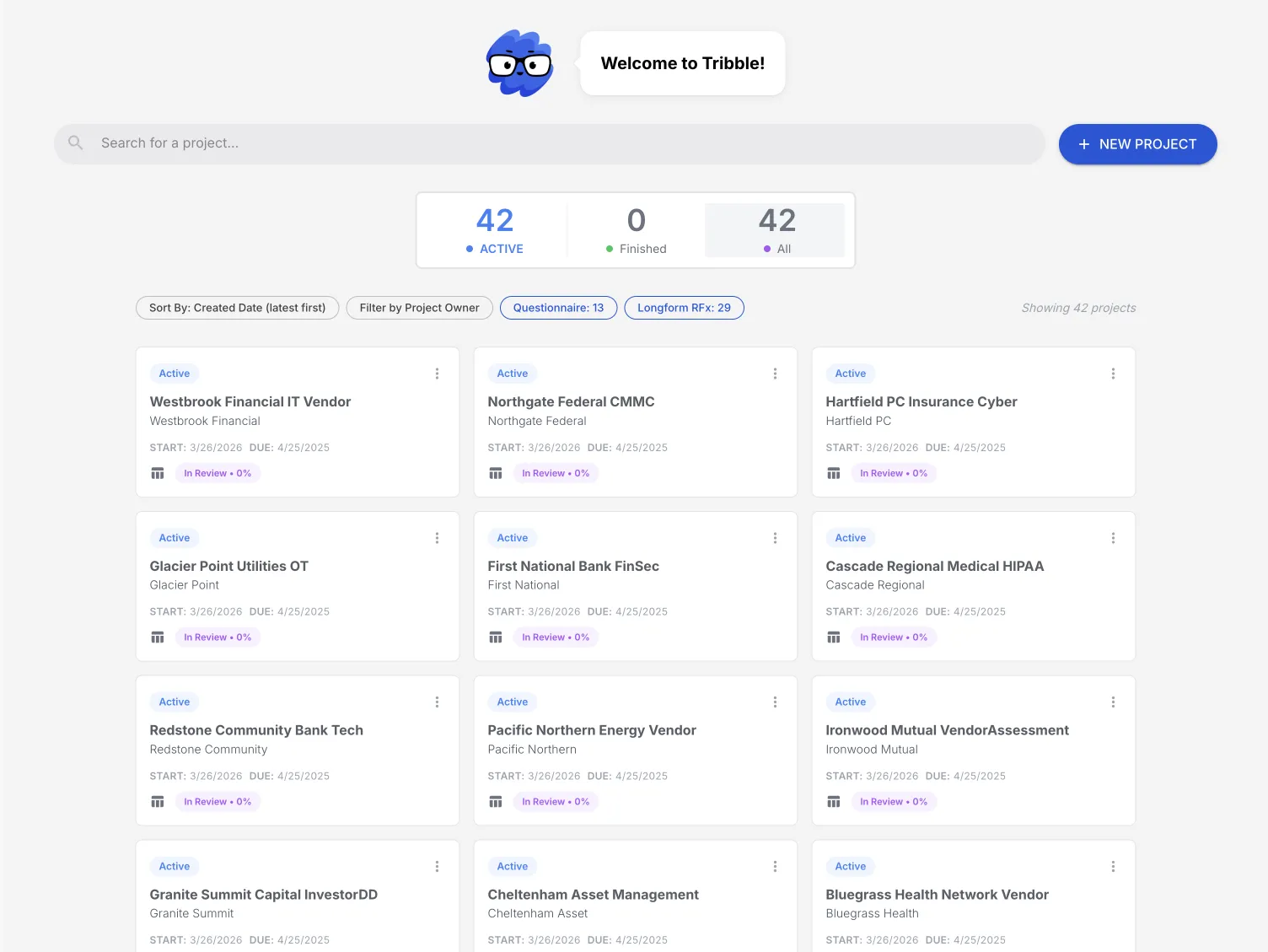
Walk through a real RFP automation workflow — upload a document, watch AI generate answers, review with confidence scores, and export. No signup required.
"Tribble has completely transformed our RFP process. What used to take days now takes hours."
Verified G2 Review
From Manual Assembly to AI-Generated Proposals: What Changes
Modern RFP automation replaces the search-copy-paste cycle with AI that reads the RFP, generates sourced answers, and focuses your team on review and strategy.
Upload any RFP format. AI handles the rest.
Import from email, procurement portals, or shared drives. The AI parses document structure, extracts individual questions, identifies requirements, and maps them to your knowledge base — regardless of whether the RFP arrives as a Word doc, Excel spreadsheet, or presentation deck.
Complete first drafts, not search results.
The AI doesn't just find similar past answers — it generates complete responses tailored to each question using your full organizational knowledge: past RFPs, product documentation, Slack conversations, and expert-verified content. Every answer comes with source citations.
Focus review time where it matters.
Every generated answer includes a confidence score. High-confidence answers need a quick scan. Low-confidence answers get flagged for expert review with the specific gap identified. Your team reviews intelligently instead of checking everything.
Your organizational knowledge, always current.
Traditional tools require manual content library maintenance. AI-native platforms build knowledge continuously from every completed proposal, product update, and expert answer. The knowledge base gets stronger over time — no maintenance cycles, no stale content.
Learn what wins and apply it automatically.
Connect proposal outcomes to the answers that drove them. AI-native platforms track which response patterns correlate with winning deals and surface that intelligence in future proposals. Your proposals get smarter with every outcome.
Get SME input without the email chase.
When an answer needs expert input, AI routes the question to the right person — in Slack, Teams, or the platform — with full context. The expert's response feeds back into the draft and the knowledge base. No follow-up emails, no dropped requests.
Enterprise-grade security and audit trails.
Role-based access, approval workflows, question locking, and complete audit trails on every answer and submission. SOC 2 Type II certification. Built for regulated industries where proposal accuracy has compliance implications.
"Tribble has completely transformed our RFP process. What used to take days now takes hours."
Verified G2 Review
Connects to every system your team already uses.
Tribble pulls knowledge from your existing tools and pushes intelligence back — no data migration, no rip-and-replace.
500,000+ questions answered. The results compound.
"Tribble has completely transformed our RFP process. What used to take days now takes hours."
Verified G2 Review"Tribble makes it easy for reps to get fast, accurate answers without hunting through internal docs."
Verified G2 Review





"Tribble makes it easy for reps to get fast, accurate answers without hunting through internal docs."
Verified G2 Review
RFP Automation Resources
Deep dives, comparisons, and practical guides to help you automate RFP responses with AI.
Best AI RFP Response Software 2026
Side-by-side comparison of the top AI-powered RFP platforms.
How to Automate RFP Responses with AI
Step-by-step guide to implementing AI-powered RFP automation.
RFP AI Agents Explained
How autonomous AI agents are reshaping proposal workflows.
How to Evaluate and Choose an RFP Platform
Framework for selecting the right RFP tool for your team.
RFP Automation Without the Learning Curve
6-step process to fast-track your RFP automation rollout.
RFP Analytics & Proposal Data
How to use proposal analytics to improve win rates and efficiency.
See AI RFP automation on your proposals.
30-minute walkthrough. Bring a real RFP — we'll show you what AI-first automation looks like in practice. No commitment required.
Book a DemoSee what AI-first RFP automation looks like.
Book a 30-minute demo. Bring a real RFP and see how Tribble generates a complete first draft with confidence scores and source citations — not search results from a content library.
Book a DemoNo commitment required. Rated 4.8/5 on G2 with 19 badges including Momentum Leader and #1 Easiest to Use. SOC 2 Type II certified.